Prom Night 1979
Stephen King Three Classic Novels Box Set: Carrie, 'Salem's Lot, the ShiningProm Night 1979 is the temporal frame for the Spring Ball held at Ewen High School on May 27, 1979, and for the disaster that continued into the next morning. The date gathers two sharply opposed kinds of record: the dance’s program and ceremonial timetable, and the later broadcasts, testimony, and death record that trace an evening of celebration into catastrophe. The night’s significance lies not only in what happened at the school, but in how its orderly schedule gives way to a crisis measured by delayed reports, damaged infrastructure, and the isolation of Chamberlain, Maine.
Date and the Dance
The dance was announced as the senior class’s Spring Ball for May 27, 1979. Its printed program named The Billy Bosnan Band and Josie and the Moonglows, listed chaperones, and set the coronation for 10:00 p.m. The Black Forest cuckoo clock had announced eight-thirty before the preparations; later, as the evening gathered pace, the time was almost nine-thirty when the students arrived for the vote. These times give the celebration a firm, public rhythm: the music changes, guests take their places, and the coronation approaches according to a schedule everyone can see.
The contest itself briefly unsettles that expected order. Victor Mooney, the senior-class president, called the audience to its seats for voting. After the ballots were counted and checked again, he announced that Tommy Ross and Carrie White had won by one vote. The result brought a moment of startled silence before applause filled the hall. Victor then proclaimed them king and queen of the 1979 Spring Ball. The narrow margin makes their elevation feel contingent, while the ceremony turns the night into a visible passage from ordinary student life to public distinction.
At ten-oh-seven, both bands joined in the school song and the audience rose, still applauding. The scheduled coronation had become a collective scene of celebration. Yet the same ceremony is shadowed by what the wider chronology reveals: Tommy was in the fading moments of his life when he took Carrie’s hand after the announcement. The dance’s official timetable records an occasion of honor; the narrative’s later knowledge makes that honor part of a tragedy already unfolding.
From Ceremony to Emergency
The records move from the school’s internal clock to the town’s external alarms. In later testimony, Sheriff’s deputy Jacob Plessy’s radio transmission informing the sheriff of trouble at Ewen High School is placed at 10:21 p.m. The first cited Associated Press ticker report, at 10:46 p.m., said a fire was raging out of control at the school and that assistance had been requested from nearby communities. At that point, the report said no casualties had yet been reported. The contrast between the early uncertainty and the disaster’s later toll is built into the sequence of dispatches.
A 11:22 p.m. report describes fire crews arriving at the gymnasium, where the prom had been taking place, to no avail. It also reports that all fire hydrants in the area had been vandalized. The emergency therefore extended beyond the burning school: the response faced damaged firefighting infrastructure as well as the blaze itself. The surviving excerpt begins to report a problem with water pressure but does not preserve the full statement, so the documented detail remains the vandalized hydrants and the crews’ inability to contain the fire at the gym.
The school’s earlier discipline of the girls involved in the shower-room humiliation provides part of the night’s background, though the cited evidence does not date that punishment to May 27. The girls received a week of detention, assigned to run under Rita Desjardin’s supervision in the gym. The punishment places the gym in a prior institutional context of enforced discipline; on prom night, reports identify that same kind of school space as the site of an uncontrollable fire. The shift is from a school attempting to impose order to a town unable to master the consequences of the night.
Midnight and the Town’s Isolation
The disaster’s chronology continues after midnight, when the crisis reaches beyond Ewen High School. At 12:10 a.m., the telephone exchange experienced a complete jam of every town phone line still in operation. Three girls working at the exchange remained at their posts but could not manage the calls. The interruption made communication itself part of the emergency: people were trying to place calls, but the system that might connect them to help or information had become unusable.
At 12:06 a.m., a gas main on Jackson Avenue was opened. The account then records an ambulance attendant from Motton throwing out a cigarette butt at 12:17 as the rescue vehicle sped toward Summer Street. At 12:18, an explosion destroyed nearly half a block, including the offices of the Chamberlain Clarion. The sequence is not simply a list of late-night incidents. It shows the disaster expanding through the town’s utilities, communications, and local press, until Chamberlain, Maine, was cut off from the country beyond it. The precisely noted minutes convey how quickly the town’s remaining connections failed.
The Date’s Afterlife
The date closes in the early hours of May 28. A death record gives Carrie White’s time of death as approximately 2:00 a.m. and lists hemorrhage, shock, and possible coronary occlusion or thrombosis among the causes. The record’s uncertainty about the precise medical cause contrasts with its firm placement of her death at the end of the night’s chronology. May 27 is the date printed on the dance program; May 28 is the date that contains the recorded end of Carrie’s life.
The temporal frame is also enlarged by later accounts. A newspaper article dated September 7 treats prom night as history and describes a town still marked by the disaster: homes on Morin Street and Brickyard Hill remain standing, but the residential landscape borders a blackened and shattered center; some houses bear for-sale signs, while occupied homes display black wreaths. A 1981 study of telekinesis, in turn, argues that the ability may surface under extreme personal stress and describes Carrie White as having possessed immense potential. These retrospective documents do not alter the sequence of the night, but they change its scale: the prom becomes both the dated point of catastrophe and the event through which later writers try to understand its human and supernatural dimensions.
Narrative Significance
The night’s time markers repeatedly set public order against breakdown. The printed program assigns music and a coronation hour; the ballot count confirms the winners by a single vote; the school song draws the audience to its feet. Then official time is registered through radio calls and AP bulletins, while the phone exchange jams and an explosion severs the town’s connection to the outside. The changing instruments of timekeeping—from clock and schedule to dispatch and death certificate—make the catastrophe legible without making it manageable.
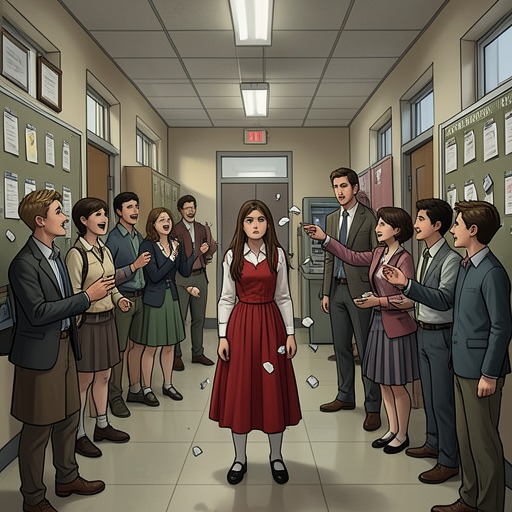
The blood imagery also links the novel’s earlier humiliation to the night’s final violence. At the shower-room incident, Carrie White steps out and the girls see blood running down her leg. During the prom, she remembers the shower and the laughter as blood is poured over her, experiencing the event as the fulfillment of the humiliation imposed on her. The recurrence transforms an earlier exposure into the defining memory of the dance. Prom Night 1979 is therefore not merely a date on which disaster occurs: it is the point where the school’s rituals of judgment and recognition culminate in a public reversal, and where the scheduled celebration becomes inseparable from the destruction that follows.